This will be the main schedule page.
Week of Feb 14
Monday 2/14
Introductions.
Read the introductory bits, pages 1-6 in book 1. Pay special attention to the tiny details. Make some lists of things that catch your attention. Then read chapter 1 of book 1. (Read further if you want, but we’ll keep it to just the first pages and chapter 1 for Monday.) Have and extra-close look at these two pages; we’ll spend some time thinking about what’s going on here and why.
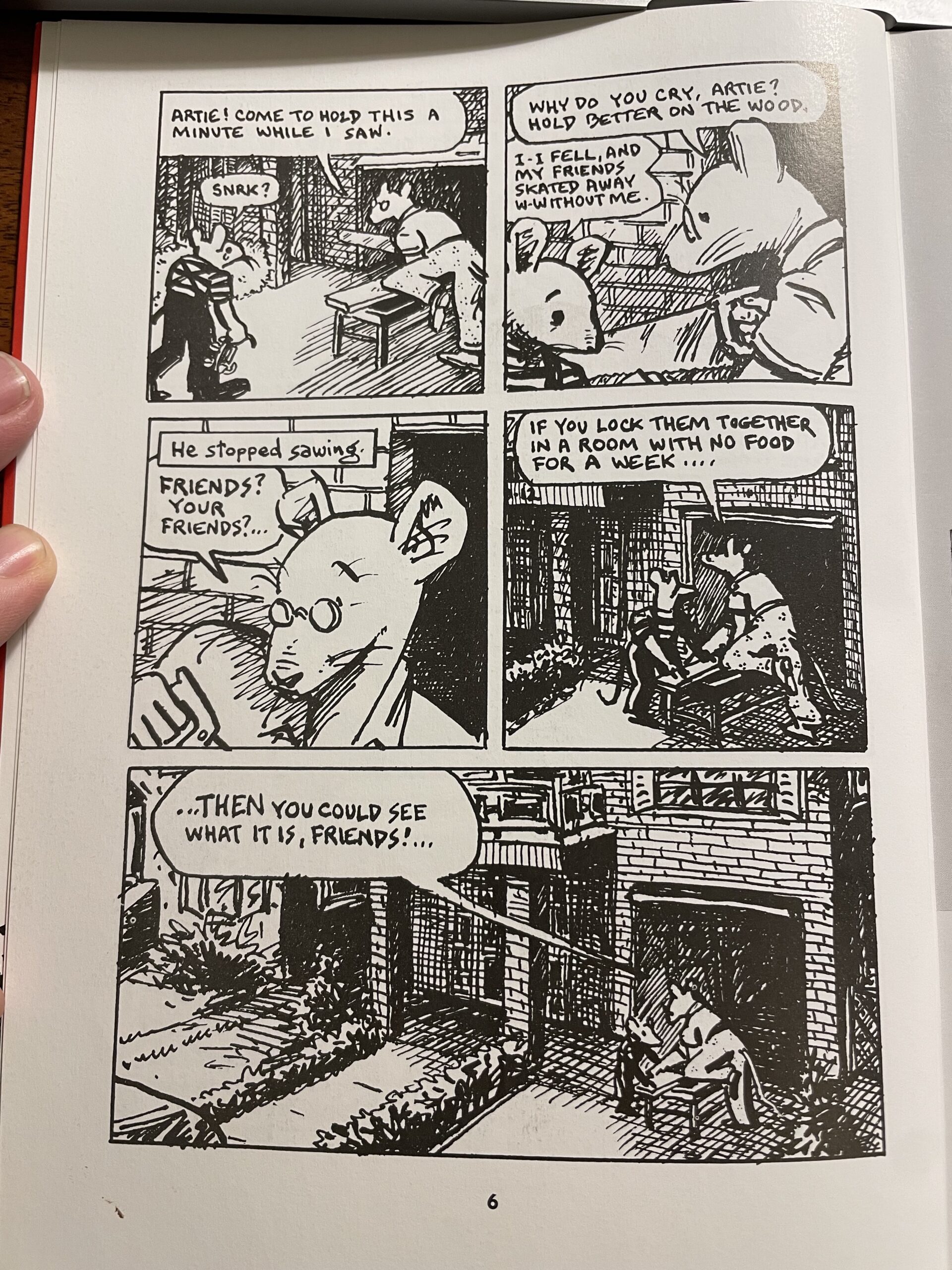
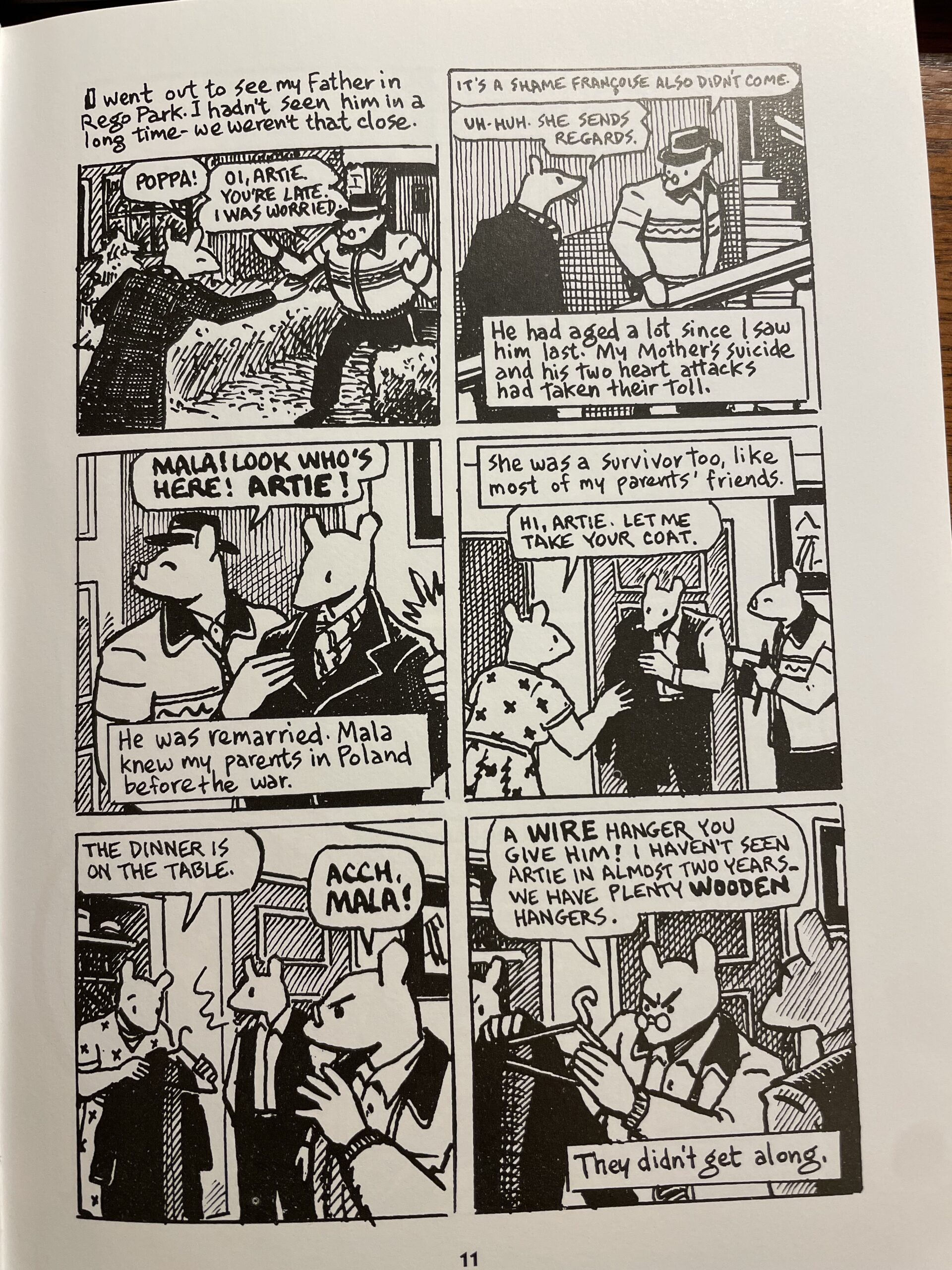
In our Monday session I’ll explain some basic background about the books, about how they came to be, about the history they describe, and about how the history is framed by this story in comics form. Then we’ll look at a few specific pages together and practice the kinds of reading that comics offer us. And time for questions. We’ll aim for about 45 minutes per session.
Thursday 2/17
This session we’ll have to skip. (I have to take my dad to the doctor on Friday morning, so have to drive to Virginia Thursday night.)
But that’s okay, because you can have a full week of undisturbed reading through the 21st.
Week of Feb 21
For next Monday just read read read. At least through the end of Chapter 4, but if you finish the Maus I that’s great.
Make a list of questions that you have as you go. Maybe organize those in categories related to the three main aspects of the book:
- history, what happened
- testimony and witnessing, how Art helps us readers listen to Vladek’s trauma, how to show and share empathy
- the comics form, how the art and words on the page work to bring the first two things (history and empathy) to us
One of the very best places for general information about the Holocaust is the US Holocaust Memorial Museum. They have great web pages.
Here is the place to start: https://encyclopedia.ushmm.org/content/en/project/the-holocaust-a-learning-site-for-students.
For a much more detailed introduction, the one I use with my Davidson students, see this book edited by Omer Bartov, The Holocaust: Origins, Implementation, Aftermath. You can download that pdf if you’d like.
Week of Feb 28
For Monday read to the end of Maus I. Think about the two lines or directions of the plot we have been talking about: the increasing difficulty for Vladek and his family to survive in occupied Poland and how that moves inevitably toward Auschwitz at the end of book I, and also the heightening awareness of the source of the difficulties between Art and Vladek, when we learn the details of Anja’s death by suicide. Think back to times in the story when Anja’s death might be foreshadowed-—her post-partum depression before the trip to the spa, her despair in some of the hiding place moments—and how Spiegelman draws and tells that arc of the story. But also remember that we know of Anja’s death in panel 2 in chapter 1. We know already.
In the context of thinking about those moments of danger and survival we mentioned at our meeting on the 21st, and the idea of Parshas Truma as some kind of divine or supernatural force at work, listen to this brief testimony by Leah Hammerstein Silverstein, a survivor who describes working under a false non-Jewish identity in Poland at this same time. (Important to know that some Jewish people in northern Europe, in Poland and the Baltics, had red hair.)
As you read this to the end, think of some of the moments for you that were ! and ? and jot those down as starting points for our meeting on Monday.
And here is some information on the Nuremberg Laws that we mentioned on the 21st, modeled in part on the Jim Crow segregation laws in the US in the 1920s and 1030s.
• Brief overview of the Nuremberg Race Laws.
• timeline of anti-Jewish laws from 1933. At the end of this article you can see passports stamped with the “J” like we see in Maus I after the big selection at the stadium in Sosnowiec.
• Here is a version of James Whitman’s book Hitler’s American Model: The United States and the Making of Nazi Race Law (2017). This is the definitive and most recent analysis of how the actual segregation laws in the US influenced the antisemitic laws in Hitler’s Germany. This is pretty detailed and dense scholarly work, so maybe save it for later. But if you need to make this argument about how the Nazis learned from American racist laws, Whitman is your guy. He writes: “In the early 1930s, as the Nazis were crafting the program of racial persecution enshrined in the Nuremberg Laws, they took a great interest not only in the way Henry Ford built cars for the masses, not only in the way Hollywood built its own mass market, not only in FDR’s style of government, not only in American eugenics, and not only in American westward expansion, but also in the lessons to be garnered from the techniques of American racist legislation and jurisprudence” (11).
Maybe read the introduction if you have time this weekend.
(Studying the way laws affect people based on their race is full-on CRT by the way, welcome to the team.)
No meeting Thursday; see you Monday 2/28.
Week of Mar 7
Maybe all of Maus II for March 7? Yes!
We’ll meet Monday 3/7 to finish the book. Then on Thursday 3/10 for a final meeting with Dr. Barbara Mann. Barbara and I met just recently around our Maus Course. She will be teaching this course for high school teachers this week.
As you read, think again about trajectory, the lines the stories follow. We have the basic history of what happened to Vladek which aligns with many stories about Auschwitz. Vladek’s survival experience is one of the lines or trajectories Art is giving is. The second is the story of Art’s coming to terms with his dad’s and mom’s stories and being able to tell them. He shows us some really telling images of how hard it is for him to do this work of storytelling, of listening – witnessing his dad’s testimony – and then writing and drawing about it. This is so much more difficult for him following the moment when he learned that his dad burned his mom’s diaries, that were meant for Artie.
There is also a moment of anti-Black racism that Art is interested in showing us. One thing we see and hear over and over again in Maus is that trauma and suffering and loss do not make you a better person. This moment of racism that Art shows us is a good example of that idea. This point is in fundamental opposition of many religious doctrines that claim that suffering makes you a better.
I’m off to bed now but will post some Ukraine resources tomorrow. Start here:
- For news straight from Ukriane, the Kyiv Independent.
